Magento Developer Certification Preparation Study Group
Session Five
Was?
EAV
Wer?
- Andreas Mautz
- programmiert seit 16 Jahren
- macht magento seit 2008
- beschäftigt sich mit Deployment-Prozessen, Entwicklungsinfrastrukturen und Wissensmanagement seit 2011
- Vorbereitung Zertifizierung
- Lehren und Lernen Stoff zusammenzufassen
Locationcation
brandung
Next: ???
Ablauf
Was machen wir denn heute Schönes?
- EAV
- neue Aufgaben
- Sonstiges
EAV
Entity–attribute–value model (EAV) is a data model to describe entities where the number of attributes (properties, parameters) that can be used to describe them is potentially vast, but the number that will actually apply to a given entity is relatively modest. In mathematics, this model is known as a sparse matrix. EAV is also known as object–attribute–value model, vertical database model and open schema.
EAV
Vorteile
- Trennt Inhalte von Attributen und Entitäten
- Verkapselung der attributbezogenen Geschäftslogik
- Mehrschichtige Inhaltsauprägung möglich
- Attributsverwaltung einfach
EAV
Hierarchie (insgesamt 147 Klassen)
- App/Code/Core/Mage/Eav/Model/Form
- App/Code/Core/Mage/Eav/Model/Form/Type.php
- App/Code/Core/Mage/Eav/Model/Form/Element.php
- App/Code/Core/Mage/Eav/Model/Form/Fieldset.php
EAV
Datenbankdiagramm
EAV
Eigenheiten
By decoupling the logical Model and the code that talks to the database,
it's theoretically possible to write new resource classes for a different
database schemas and platforms while keeping your Models themselves untouched.
EAV | Struktur
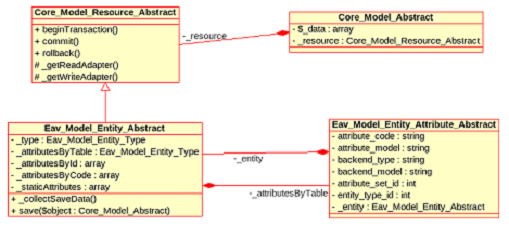
EAV | Load
Load entity’s attributes into the object
- Read data from the main table (main table or entity table)
- Define the attribute set of the object
- Read the attribute’s value of the object
- Change the attribute’s value (through the backend_model of the attribute)
- Map date into the object
EAV | Save
Save entity’s attributes into the object’s resource
- Take data mapped in the object
- Change the attribute’s value (through the backend_model of the attribute)
- Save data to the main table (main table hay entity table)
- Save data to the attribute’s value table
EAV | Unterschiede
| EAV | regular | |
|---|---|---|
| Load | Join relevant tables together, then passing data to the object | Save to multiple tables |
| Save | Direct select from database | Save to unique table |
Attribute management | Bereiche
- Frontend
- Source
- Backend
Attribute management | Interfaces
- Frontend Interface - Frontend is providing the user interface for the attribute
- Source Interface - Source is providing the selection options for user interface
- Backend Interface - Backend is responsible for saving the values of the attribute and performing pre and post actions
neue Hausaufgaben!
für Session 6:
===========================================
Use a setup script to add a catalog/product select attribute using the Magento eav/entity_attribute_source_table. Also add some options
Add a customer/customer multiselect attribute using a customer source and backend model. Make it possible to unset all options for that attribute on customers using the Admin interface.
Add a catalog/product select attribute with a custom source model that is indexed by the flat table indexer, and that also works in the layered navigation.
Use a backend model to set the associated page and store_id entity properties.
Create an uninstall script (which would need to be run manually) from the comments module that leaves Magento in a state as if the module had never been installed.
Sonstiges
Quellen && nützliche Links
Magento
Danke!
 Andreas Mautz || andreas.mautz@webvisum.de || webvisum.de